-
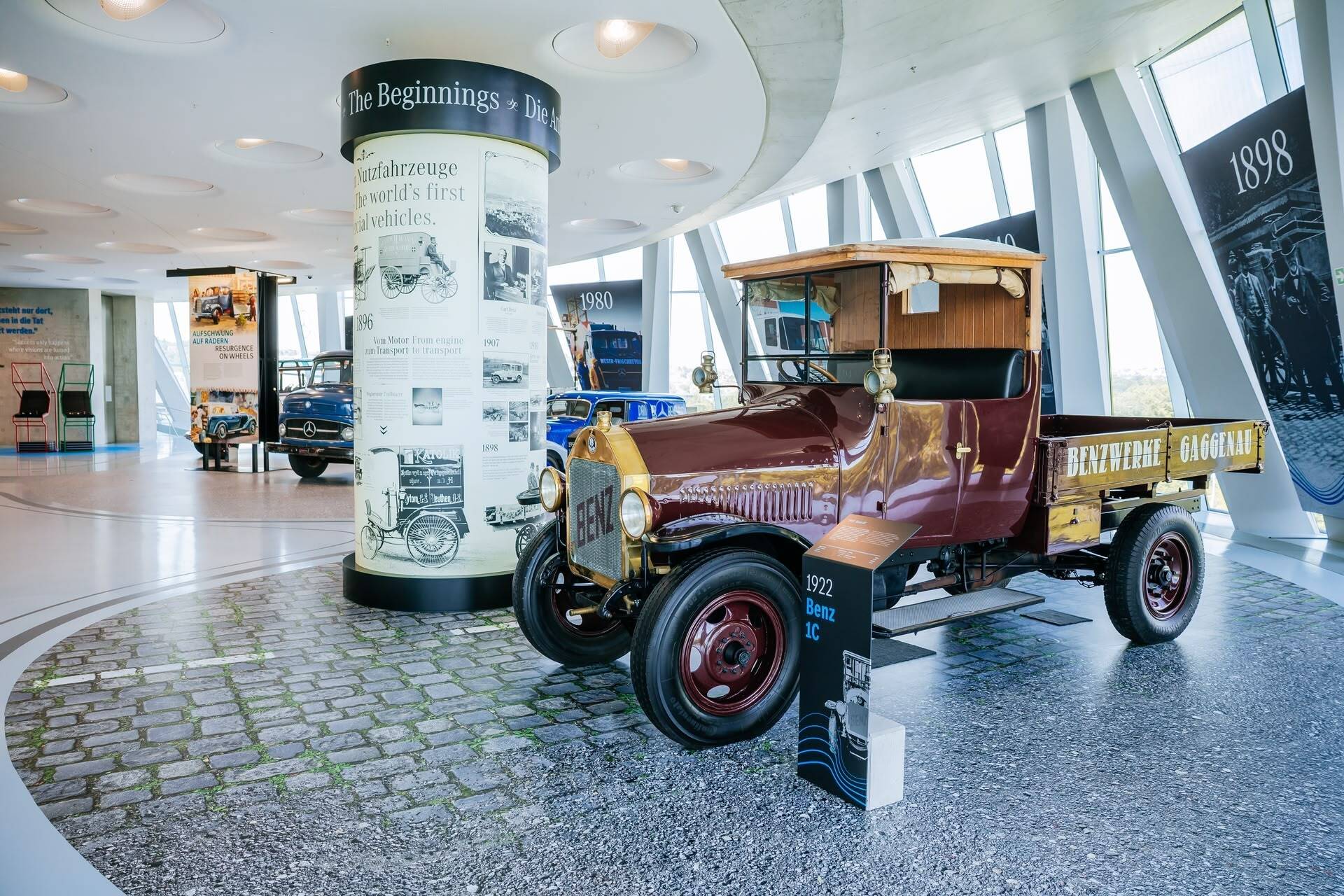
Exhibit from the special exhibition “130 Years of Commercial Vehicles”
at the Mercedes-Benz Museum
-
First, a fire-fighting vehicle, then a recovery truck from 1932 and
finally a platform truck
-
Amazingly modern: Cardan shaft drive and pedal mechanism based on
modern designs
“Close-up” – the name of this series from the Mercedes-Benz Museum says it
all. Each instalment tells surprising, exciting and interesting stories
about vehicles from the exhibition. In the spotlight this time: the Benz 1C
in the current special exhibition “130 Years of Commercial Vehicles”. It
features seven exhibits from the history of Mercedes-Benz vans and trucks
dating back to 1896 and will be on display until 4 April 2027.
No. 8/2026: 1922 Benz 1C
One number, one letter: 1C – a model designation could
hardly be any more straightforward. But it does reveal quite a lot about the
technology behind this truck. The “1” stands for one tonne of payload. The
1C therefore belongs to the light class. The “C” is derived from “Cardan”
and refers to the rear-wheel drive via a cardan shaft. With this power
transmission, clearly visible beneath the vehicle, the Benz 1C was
state-of-the-art in the early 1920s.
From fire-fighting vehicle to flatbed truck: During a
restoration, this Benz 1C was fitted with its current platform body. It was
originally delivered to the Stuttgart Fire Brigade in 1922 as a crew
vehicle. The driver’s cab is completely open, and the emergency services
crew could sit out in the open, too, on the flatbed on folding benches along
both sides. The truck was supported by solid rubber tyres on spoked wheels.
Ten years later, the truck began it second career: in 1932, it was converted
into a recovery vehicle. It retained the current enclosed cab as well as the
spoked wheels, which were fitted with more comfortable pneumatic tyres.
Although “closed” is only true to a limited extent: the side openings can
only be closed off against the wind using fabric. A heater? Not on
board.
With an eye on the roadside: The steering wheel was on the
right – which was the standard position at the time, despite the fact that
traffic drove on the right in Germany. This allowed the driver to see the
right-hand side of the road more clearly on unpaved, narrow roads. The
general switch to left-hand drive took place from the mid-1920s onwards. Two
levers protrude next to the driver’s seat: the gear lever and the handbrake.
The hand pump on the steering column was used to build up fuel pressure
before starting the engine.
Footwork just like today: Back then, the pedals were
arranged in the same way as they are today: accelerator on the right, brake
in the middle, clutch on the left. In the early 1920s, this was by no means
the norm, as at that time the accelerator pedal was often still positioned
in the centre – with operating mechanisms that would seem highly unfamiliar
today.
Bare minimum: From today’s perspective, the cockpit looks
extremely basic. The wooden partition separating the engine compartment is
fitted with nothing more than an oil pressure gauge. In the control panel to
the right of it, the push-button activates the starter motor when the
ignition key is inserted. The red indicator light shows that the function is
active. The light is switched on and off by means of a rotary knob. There is
no speedometer. The 1C’s maximum speed was just 42 km/h. There was no limit
for the fire-fighting vehicle in active duty. And when towing a load, the
recovery truck was likely to always travel below the applicable speed
limits.
Rules for drivers: It wasn’t just steering, changing gears
and braking that demanded the driver’s attention. In addition, the engine
needed to be fine-tuned from time to time during driving; the fluctuating
petrol quality, in particular, made this necessary. That is why the ignition
timing and idle speed could be adjusted directly from the steering wheel.
What engine electronics now handle automatically in modern vehicles used to
be part of a chauffeur’s job. He wasn’t just a driver, but also an engine
operator.
Hill-start assist: Modern vehicles are automatically
prevented from rolling backwards when setting off up a hill. The 1C reflects
the state of the art at the time: using a cable pull, the driver could lower
a thick spike between the rear wheels, which, under the weight of the
vehicle, drives into the ground and supports it; tarmac roads were, after
all, a rarity in those days. The driver was then able to coordinate the
accelerator and clutch with ease on steep slopes to get the truck moving. He
then used a cable pull to return the spike to its original position.
Four cylinders at work: There was a petrol engine under the
bonnet. Its four in-line cylinders produced 26 kW (35 hp) from a
displacement of 4,710 cubic centimetres. What sounds quite modest today was
a respectable achievement for a one-tonne truck in 1922. Incidentally, the
diesel engine was, at that time, just about to make its world début: in
1923, Benz unveiled the world’s first diesel-powered truck, which was to set
the standard for all kinds of commercial vehicles for decades to come.
Light from two eras: The Benz 1C is a fine illustration of
technological change. The two carbide lamps near the windscreen were likely
to have been part of the original equipment. Electric lighting was added to
the front later on. The old and the new stand side by side: carbide lamps
produced their light using a flame, whilst electric incandescent bulbs were
lighting the way to the future of motoring. The full-beam headlights were
operated using the large foot switch to the left of the pedals.
Made in Gaggenau: “Benzwerke Gaggenau” is emblazoned on the
sides of the platform body. The badge at the top of the radiator also states
“Benz Gaggenau” as the place of origin of the Benz 1C. In 1907, the
Mannheim-based company Benz & Cie. took over the car factory that had
been operating there since 1894, renamed it Benzwerke Gaggenau GmbH and
concentrated its commercial vehicle production there. Today, this Daimler
Truck AG site manufactures gearboxes, axles and individual body-in-white
components.
Pioneers of road logistics: Vehicles such as the Benz 1C
marked the beginning of a development that continues to shape our everyday
lives to this day. Early trucks made freight transport more flexible, faster
and less reliant on rail and waterways. Over the decades, these pioneers
gave rise to increasingly specialised commercial vehicles – the foundation
of today’s road logistics.
The Mercedes-Benz Museum is open daily from Tuesday to Sunday, 9 am to 6
pm.
The ticket counter always closes at 5 pm.
Registrations, reservations and the latest information: Monday to Saturday
from 9 am to 6 pm by
phone 49 711 17-30000, by e-mail to classic@mercedes-benz.com
or online at
www.mercedes-benz.com/museum
Pictures